Showing posts with label Harmful Sensation. Show all posts

Thursday, October 15, 2009

Cronenberg in Context: Videodrome (1983)

The following post contains spoilers, but probably won't make any damn sense if you haven't seen the movie anyway.

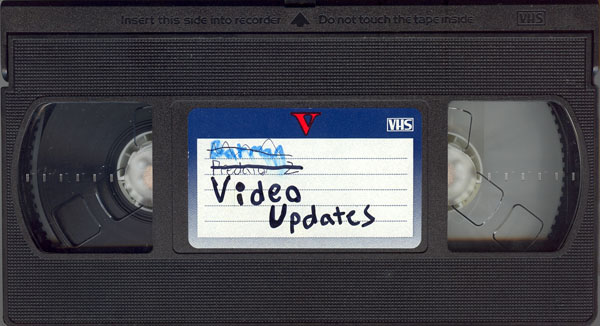
This may come as a shock to you, but I loves me some Videodrome. It is probably my all time favorite movie, and it certainly had a massive influence on the disheveled 16 year old version of me who picked up its sun bleached plastic case at a rapidly decaying Mr. Movies. Despite the existence of a most excellent Criterion Collection release, this is arguably the best way to experience Videodrome for the first time. The film practically craves the blurry texture and fuzzy tracking problems of a long neglected analog video tape. It certainly goes out of its way to work the medium's technical, physical, and cultural artifacts into the mise en scène.As a bona fide high school AV nerd spending as much time as possible with the half broken, second hand video production equipment, I was also essentially Videodrome's ideal viewer. The great rack-mount towers of oscilloscopes, VTRs, and broadcasting equipment fascinated me with its clunky DIY aesthetics and odd juxtaposition (sometimes simultaneously) of the advanced and the antiquated. I was completely taken by the film's zeitgeist, so the occasional nudity and infamous bizarro-gore were merely the icing on the cake.This analog-philia, combined with the weirdly artificial grime of the Toronto back alleys in which much of the film takes place (it's like no one has cleaned in decades, but no one has been littering either) gives the film a subtle vibe of alternate reality. I like to call it "tubepunk" or "analog-punk," because while it is obsessed with the ramifications of advancing technology, the real world has long ago surpassed it in ways it only dimly perceived. One character gives a fairly accurate prediction of 'user names' and the Internet's egocentric pseudo-anonymity, while another decries the socially destructive effects of media over-stimulation, a laughably quaint idea coming out of 1983. On the other hand, it is too obsessed with looking forward and too subtly different from the '80s as we knew them to ever truly feel like the past. The result is a fascinating world that is sadly unique to the film that spawned it. (Hence my clamoring for a video game sequel, and decrying of a "modern" remake.)For Cronenberg's career, Videodrome marks a clear turning point in his slow evolution from high concept horror auteur to a more mature director of cerebral thrillers. It's also arguably his first truly good film, unmarred by the weak performances that periodically raise their heads in his earlier work (I'm looking at you, dude from Scanners), and completely saturated with dark subtext. Films like Scanners and The Brood obviously had a lot of ideas and certainly revolve around his favored themes, (the power of the mind over the physical world, gooey abjections of the human form) but Videodrome takes these ideas and runs with them.One theme, further explored in the film eXistenZ, is the traumatic effect of exposure to alternate layers of reality. When protagonist Max Renn (James Woods) is exposed to the Videodrome signal, he begins having hallucinations so vivid that they cannot be distinguished from reality. Another character, Professor Brian O'Blivion, suffers from a Videodrome induced brain tumor (similar to the emotion fueled cellular carnosity in The Brood) that he postulates is actually a new organ with the ability (purpose?) to create an even closer relationship between the mind and the cathode ray tube. "Television is the retina of the mind's eye," he frequently proclaims, possibly meaning that Renn's hallucinatory experiences with the Videodrome show and signal are the result of his consciousness being extended into the television program. Once the boundaries between meatspace and the 'video' world are totally blurred, it becomes impossible for Renn and, by extension, the audience to tell exactly how real the events on screen are, and how characters untainted by the signal are perceiving the events.
For instance, Max gets a crazy mutant gun hand, but when he is brainwashed into murdering his unaffected business associates he merely shoots them with a totally normal weapon. This gives the impression that his fleshy new powers only exist within his Videodrome fugue state. (Perhaps other victims of the signal could also see them.) However this is later contradicted by an unaffected character getting his hand mutated into a flesh grenade, which background extras react in horror to, after sticking it into Renn's stomach vagina along with a mind controlling video tape. What exactly were these unaffected characters witnessing and what are the ramifications for the seperation between the real hallucinatory worlds.

The film gives no easy answer to the above question, which merely scratching the surface of possible textual analysis. There are many more interesting questions about perception, censorship, the motif of harmful sensation, the social effects of violent and pornographic media, and our relationship with media in general. Max has a career as a small time cable pornography provider eager to break the next taboo. There are repercussions of the Videodrome signal's increased effectiveness under sexually violent imagery, as well as the hints of vast, moralistic, right wing conspiracies. There's enough to chew on in this 89 minute film to write a whole book. In fact someone did! (Which I confess I have yet to read.)Videodrome: way more than "that movie where James Woods has a stomach vagina," (though it certainly is that too) or a Family Guy joke about nudity. Buy it, steal it, Netflix it. If you are in Minnesota, the Trylon Microcinema just had a showing and will be doing more Cronenberg movies through the end of October. I'll be attempting to catch all of them, so drop me a comment if you're going as well.

"It has a philosophy. And that is what makes it dangerous."

Tuesday, August 4, 2009

Pontypool & The Motif of Harmful Sensation

Danger! The following post contains a dangerous, highly contagious meme, as well as major spoilers for the excellent new film Pontypool. For your safety and the safety of all you communicate with, do not read any of the red text below. I repeat, do not read the red text.

The 'motif of harmful sensation' is an inelegant term for a concept that occasionally crops up in horror and speculative fiction in which mental or physical injury is sustained through a perception rather than physical interaction. Instead of axes, chainsaws, and machine guns, damage is done via sounds, imagery, or even abstract thought itself. (A million points to anyone who successfully coins a better term.)

There is an immediate and powerful common-sense impulse to immediately dismiss the concept as absurd, but there are plenty of less fanciful examples of harmful sensory input in the real world. For instance, the eyes and ears can be easily damaged by overloading; if you doubt this, stare directly into the sun while listening to Slayer on your iPod with the volume turned way up. Some sufferers of epilepsy will lapse into dangerous seizures when exposed to pulsing lights or Pokemon cartoons, while everyone can be psychologically harmed by traumatic sensory input. (Such as a recording of the untimely demise of a loved one.)

When a fanciful imagination combines this relatively mundane concept with the philosophical gray area between the brick and mortar reality around us and the perception filtered reality in our heads, the idea of harmful sensation spirals outwards. One of the earliest and most famous examples comes from the mythological Medusa, a gorgon so monstrous that any who looked upon her would turn to stone. She is eventually slain by Perseus, who only looks at her reflection during the battle, thanks to a mirrored shield. This loophole implies that it is not merely her epic ugliness that calcifies her victims, but some sort of magic radiation that is not reflected with the visible spectrum. Of course it is possible the polished bronze shield was not a perfect mirror, giving the hero enough information for combat purposes while leaving the lethal details indistinct.Modern tales of harmful sensation often focus on technology; specifically how society's newfound ability to easily record, duplicate, and spread information could become a vector for spreading a pandemic if a chunk of that info became toxic. In David Cronenberg's infinitely excellent Videodrome, a small time pornographic broadcaster becomes embroiled in a massive conspiracy after discovering a mysterious video signal that causes hallucinations, mind control, and possibly physical mutations in anyone who sees it. Since overexposure causes madness and death, the sinister forces of purity want to implant the signal behind the porno in order to infect the population's undesirables.In the aptly named The Signal, a similar madness inducing broadcast is sent out across all phones, radios, and televisions, both disrupting normal communications and driving everyone rather nutty. Like the Videodrome signal, the effect is irreversible and its intensity correlates with the length of exposure, but rather than being surreptitiously hidden behind certain programming, it is blasted across all mediums as aural white noise and trippy visuals.In the realm of J-horror, harmful sensations are also found lurking within various technological marvels, but unlike the West, they are almost exclusively supernatural in origin. In The Ring series, a cursed videotape created by the malevolent spirit of a troubled psychic causes its viewers to be killed by said spirit exactly seven days later. In Kiyoshi Kurosawa's epic Pulse (aka Kairo) ghosts invade the world via the internet and begin draining everyone's will to live via making scary eye contact with them.
In all of the above examples, be they based in science or spirituality, the harmful sensation is transmitted directly through the act of observation. The damage is done directly by the malicious photons or sound-waves entering the sensory organs, whether or not the victim is even consciously aware of it. In the Canadian pseudo-zombie flick Pontypool and its ilk, the concept of harmful sensation becomes even more abstract. Videodrome (also Canadian) involves what is essentially killer visual radiation; Pontypool, on the other hand, trembles in fear of the dread 'killer meme.'

Memes, as you should know (you are using the internet, after all) are chunks of cultural data that can be passed from brain to brain. They can take the form of lolcats, jokes, masturbation techniques, songs that get stuck in your head, and basically the entirety of Internet culture. In one of Mark Twain's lesser known tales "A Literary Nightmare," the narrator becomes obsessed with a catchy jingle he sees in the newspaper (How does that even work? Does it come with sheet music?) and finds his brain crippled by distraction. After inadvertently infecting a friend, he finds himself cured, then helps his victim find similar relief by spreading it to a university class. Like in The Ring, the only relief is to continue circulating the meme/jingle/evil tape, but as it is a memetic harmful sensation, Twain had to understand the jingle in order to be affected by it. A meme in a foreign language is rendered powerless by its incomprehensibility.

Monty Python's Flying Circus portrayed the prototypical killer meme with the "Funniest Joke in the World" sketch, where the English discover a joke so funny that all who hear it die laughing. After sacrificing many lives to contain the joke, they translate it into German to use in World War II. The process has to be done one word at a time, as even viewing two in sequence causes hospitalization, but proves quite effective on the battlefield. The Brits can merely read the joke phonetically to slaughter whole battalions, and never have to understand the fatal witticism themselves.
Not too many nuggets of information can induce the massive emotional responses required for lethality, so instead of a factoid or joke, the 1980s era Twilight Zone episode "Need to Know'' has at the center of its harmful sensation, nothing less than the very meaning of life. The dude from CSI has to help Francis McDormand find out why a small town is going insane, and they discover that a local weirdo back recently from 'the East' (dun-dun-du-un!) has figured out the meaning to existence, which naturally drives all who learn it hopelessly insane.

The Videodrome signal is more important that the video image carrying it, and not all malevolent memes are simple deliveries of forbidden or obsessive knowledge. As the concept climbs higher and higher, the act of understanding itself is subverted. In the cyberpunk thriller Snow Crash, the Sumerian tongue turns out to be a sort of proto-language upon which other languages are built, allowing those who understand it to be programmed like computers. It was abandoned after some mean person introduces a linguistic virus that crashes brains faster than [witty software joke not found]. The virus is later recreated as a black and white bitmap that only affects those familiar with binary code.This all brings us to Pontypool, which is such a fan of Snow Crash that it uses a copy of the book as a prop. In the film, a small town radio station is caught between a snowstorm and a mysterious plague of violent madness that is slowly revealed to be spread through the English language itself. Unlike previous examples, the damage is not tied to any specific chunk of information, but jumps around from word to word. Terms of endearment are apparently particularly susceptible, but no English word is truly safe. People seem to be initially infected via exposure to the mad ramblings of other victims, but do not start showing advanced symptoms until they attempt to express themselves with certain specific words. In this case, spreading the meme is integral to its dangerous nature. They become confused by the words and begin repeating them, apparently unable to resolve something in their head. Eventually the disorder renders them completely unable to communicate or think properly, and in the final stages they violently attack anyone (or anything) that is producing intelligible speech before ultimately expiring.The film never establishes its rules in stone (perhaps the novel it is adapted from does) due to the limited information available to the characters, but they manage to find a few loopholes nonetheless. Only spoken English is affected; using broken French, writing, and thinking (at least pre-symptoms) are relatively safe. Once a person starts showing the first symptoms, there are two courses of action explored in the film: either they can produce an endless stream of non-English speech to prevent themselves from focusing on their infected word, or they can attempt to rob the word of its meaning. One character postulates that the infection copies itself during the act of understanding a word, but unfortunately this is usually a reflex rather than a conscious act. *Mega Spoiler* During the climax, the last survivors manage to (at least temporarily) save a character by chanting a nonsense phrase intended to make the word seem alien, halting the infection in its tracks instead of letting it spread through the victim's desperate, disordered attempts to 'understand'. *Mega Spoiler Over*
Starring a real life Mummy... who is actually pretty awesome.

There has already been some mild criticism of Pontypool for its outlandish premise. Obviously there is absolutely no scientific basis for a virus that can be transmitted through language, but the fact is that the film's trapped characters are merely using the term 'virus' as a stopgap for a concept that they don't (and possibly can't) ever fully understand. Like a virus, it is dangerous and transmissible, but that is the extent of the similarities. (It should be noted that Snow Crash's virus does make the jump to the physical world.) A more apt comparision for the Pontypool disorder would be prions, which are infectious particles of mis-folded protein responsible for diseases like mad cow or Kuru, the cannibalism spread 'laughing' disease. Prions generally infect the brain tissue, and as more and more proteins fall victim, the organ is essentially eaten away. This is not to say that the disease is literally a prion, but it does function in a very similar way. Rather than a mis-folded protein, it's a scrambled meme. It wreaks havoc on those who fall under its influence then uses them to spread itself to more victims.

It's hard to predict where harmful sensations will pop up next. I'm pretty sure Pontypool is scraping the ceiling of this highest of high concepts, but as information technology continues its rapid clip, there will be innumerable opportunities to apply the idea. My best guess is that we will see the rise of the Deadly Tweet in the not too distant future.
For a zombie centric take on the film, check out Where the Long Tail Ends.

Monday, August 3, 2009

The Killer Meme

Here's a word cloud of things to come. It's amazing how fast things can spread in cyberspace, especially when those things are Ghost Busters 1954. The keyboard cat alone grows like kudzu. Makes you wonder what would happen if someone created a meme that could cause real damage.

Cloud via Wordle
Wordle: The Motif of Harmful Sensation